
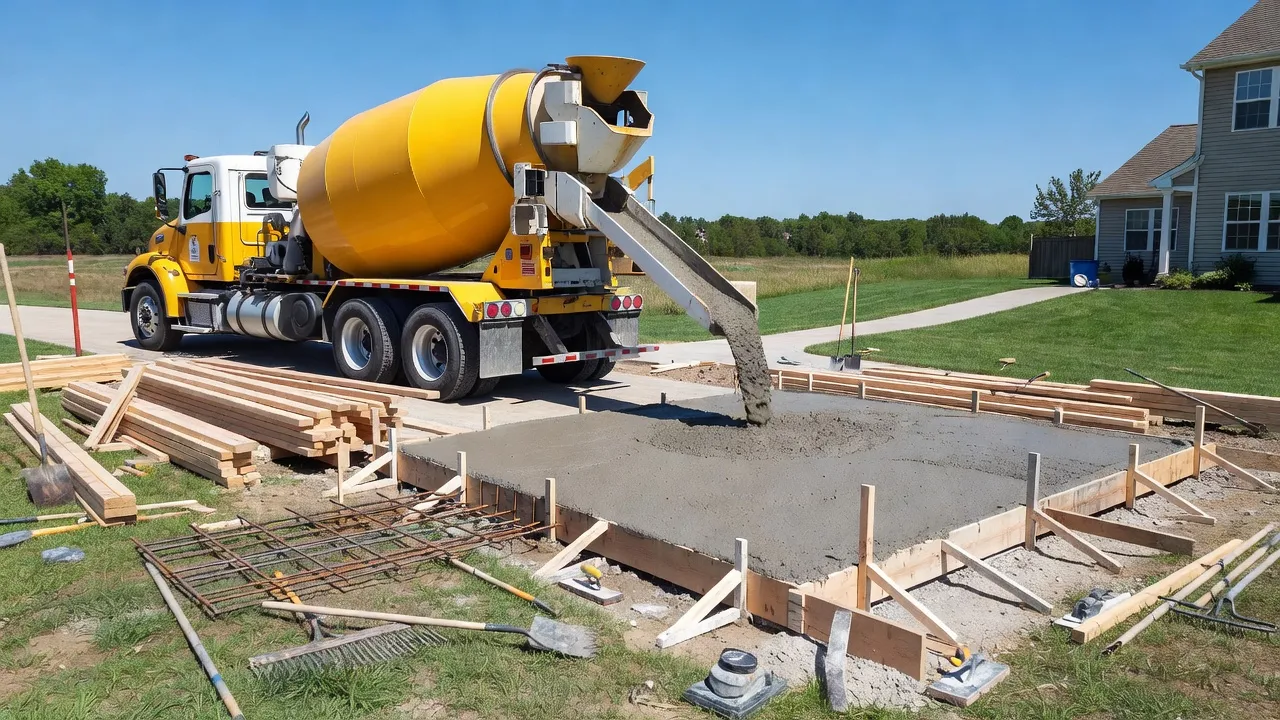
A standard full-size ready-mix concrete truck holds 10 cubic yards of concrete when filled to its maximum drum capacity, though batch plants usually load only 8 to 9 cubic yards per trip due to highway weight limits. Wet concrete weighs approximately 4,000 pounds per cubic yard, so carrying a full 10-yard load puts the gross vehicle weight close to 70,000 pounds. For small home projects like patios, footings, or small driveways, local suppliers often dispatch smaller short-load trucks carrying between 3 and 6 cubic yards.
Knowing exact truck capacities prevents two costly mistakes on a job site: ordering too little and facing a short-load penalty for a second delivery, or ordering too much and paying for wasted material. Whether you are pouring a backyard slab or estimating a foundation wall, understanding how concrete volume translates to truckloads keeps your budget and scheduling on track.
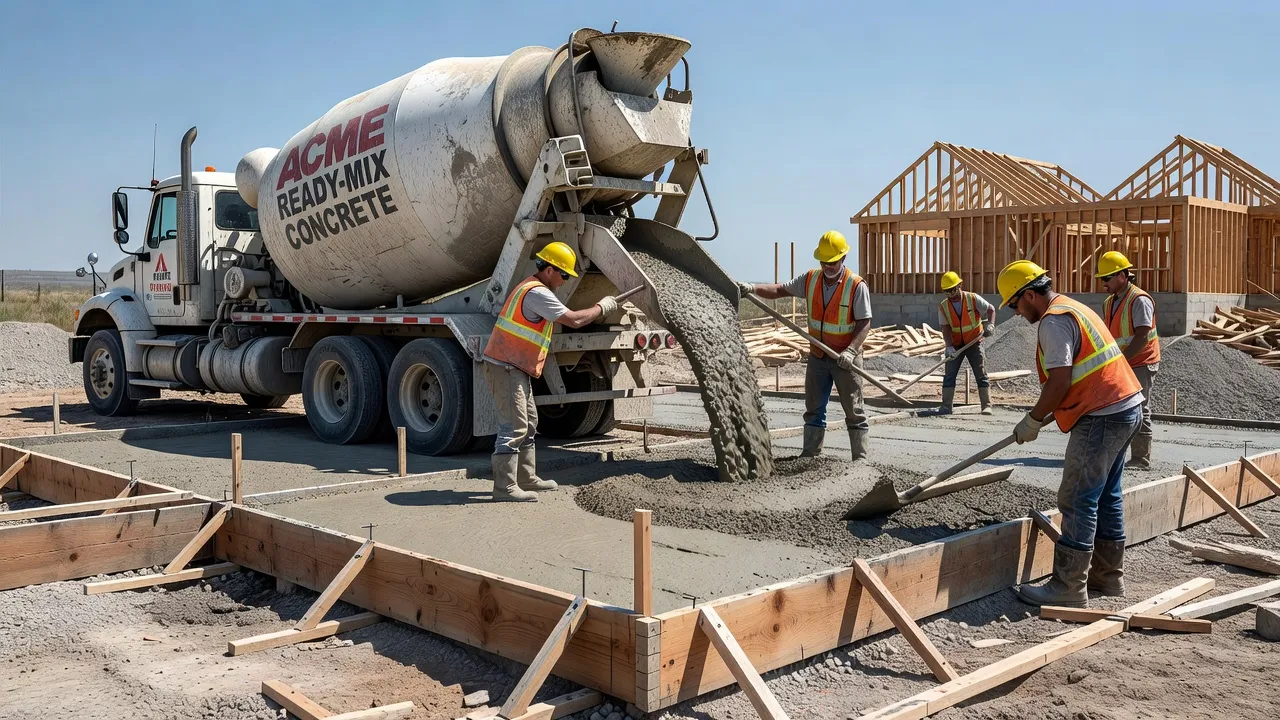
What are typical ready-mix truck capacities like 8, 9, 10, or 12 cubic yards?
Standard commercial ready-mix trucks feature gross drum volumes between 9 and 14 cubic yards, but their operational hauling limit sits between 8 and 10 cubic yards of mixed concrete. Concrete drums require empty space (known as freeboard) to mix aggregate, water, and cement thoroughly while driving. Loading a drum to its absolute geometric limit stops the mixing action and causes material to spill out during acceleration or uphill travel.
Here is how standard ready-mix truck sizes compare across the ready-mix industry as of October 2026:
| Truck Classification | Maximum Drum Capacity | Typical Legal Payload | Weight of Concrete (lbs) | Ideal Project Type |
|---|---|---|---|---|
| Mini / Short-Load Truck | 4 to 6 cu yds | 3 to 5 cu yds | 12,000 - 20,000 lbs | Sidewalks, shed pads, post footings |
| Standard Rear-Discharge | 10 to 12 cu yds | 8 to 10 cu yds | 32,000 - 40,000 lbs | Residential driveways, large slabs |
| Front-Discharge Truck | 11 to 12 cu yds | 9 to 10 cu yds | 36,000 - 40,000 lbs | Tight access lots, foundation walls |
| Super Dump / Multi-Axle | 13 to 15 cu yds | 11 to 12 cu yds | 44,000 - 48,000 lbs | Commercial foundations, highway paving |
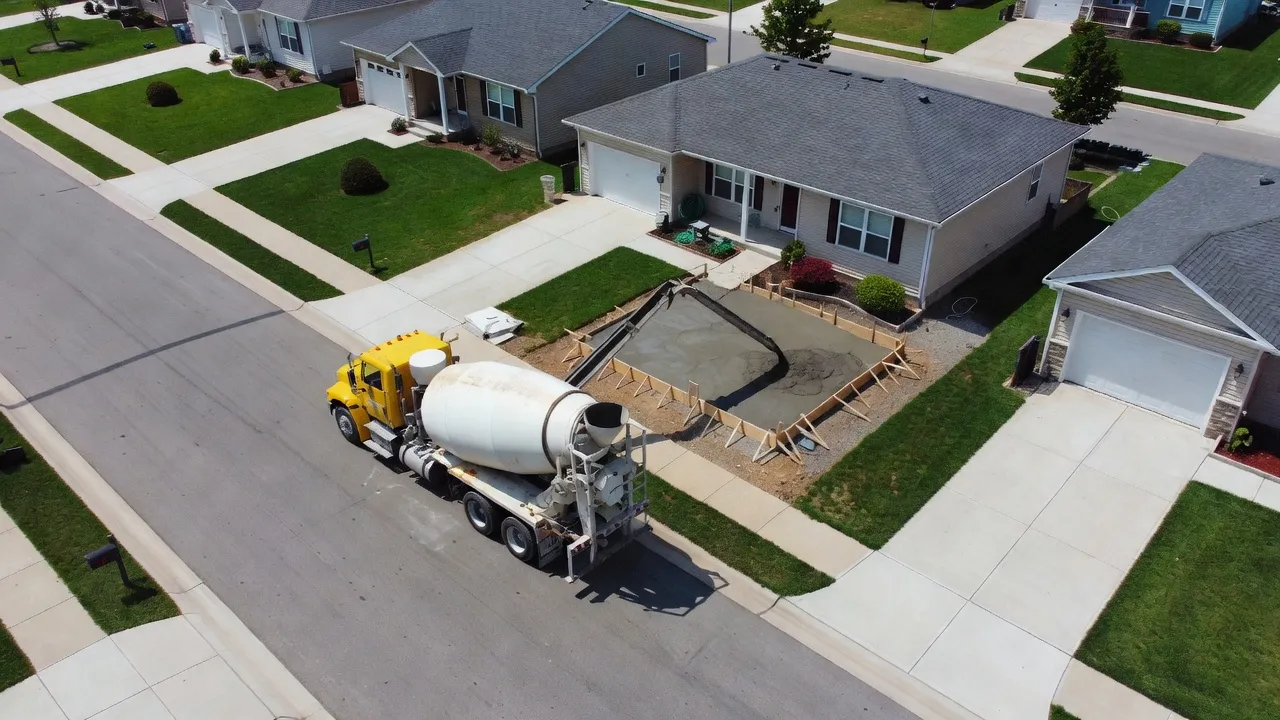
Rear-discharge trucks remain the most common vehicles seen on residential jobs. The driver must back up toward the pour site while a worker operates the discharge chute manually from behind the rear wheels. Front-discharge trucks allow the driver to steer the chute directly from inside the cab, making them faster to unload on open sites.
Smaller mini-mix trucks carry between 3 and 5 cubic yards. These smaller vehicles weigh significantly less, making them ideal for residential yards where a heavy 70,000-pound truck might crack existing asphalt driveways or destroy underground sprinkler lines.
How road weight limits restrict how much concrete a cement truck holds
State bridge formulas and legal gross vehicle weight limits constrain most ready-mix trucks to 8 or 9 cubic yards per load, even if the mixing drum can physically fit more. The federal gross vehicle weight limit on interstate highways sits at 80,000 pounds unless a carrier holds state-specific heavy-haul permits, according to weight regulations published by the Federal Highway Administration. Because a standard three-axle mixer truck weighs around 30,000 pounds empty, adding 10 cubic yards of concrete adds another 40,000 pounds, pushing the total right up against local bridge restrictions.
Concrete weight depends on the aggregate mix, but standard ready-mix weighs about 145 to 150 pounds per cubic foot. That translates directly to 3,915–4,050 pounds per cubic yard. Here is how that payload breaks down by volume:
- 1 Cubic Yard: ~4,000 lbs
- 5 Cubic Yards: ~20,000 lbs
- 8 Cubic Yards: ~32,000 lbs
- 10 Cubic Yards: ~40,000 lbs
When dispatching trucks across municipal streets with strict 5-ton or 10-ton axle weight limits, batch plants reduce the batch load down to 7 or 8 yards to avoid municipal fines. If your project requires 18 cubic yards of concrete, do not expect a single truck to deliver it all. The batch plant will split the order into two separate truckloads carrying 9 yards each.
How big is a cubic yard of concrete and how do you calculate it?
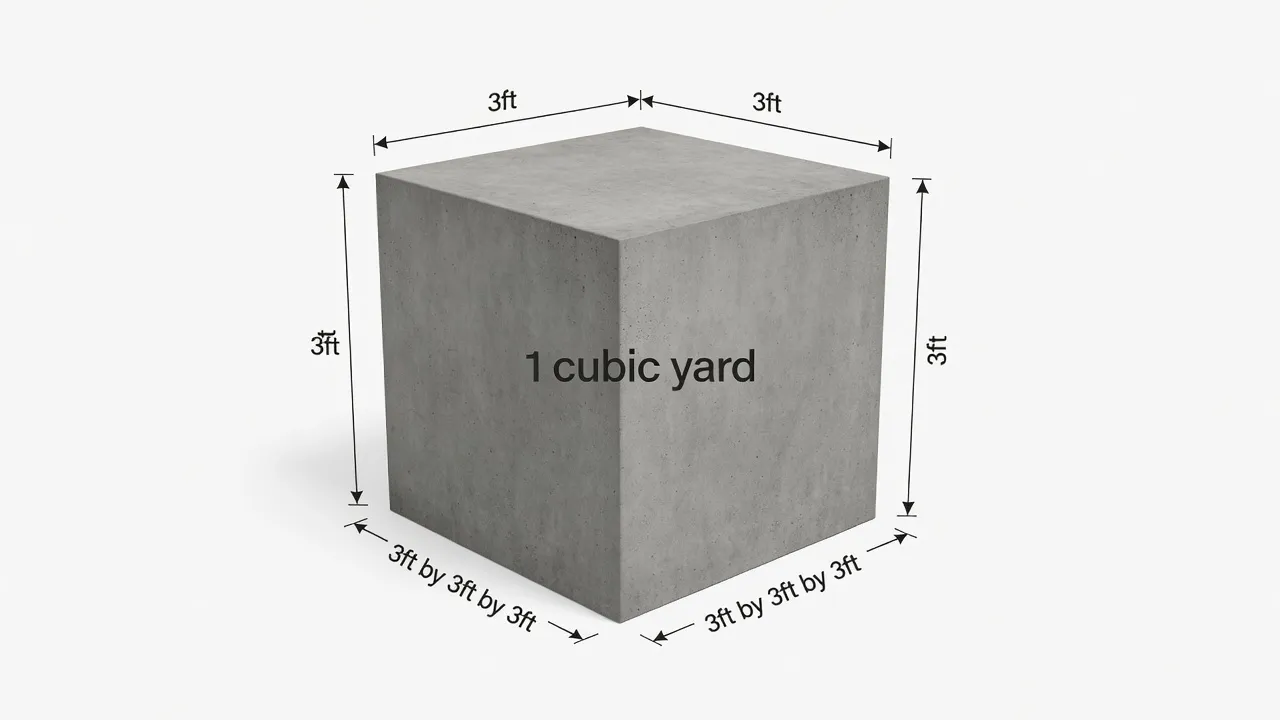
One cubic yard of concrete is a three-dimensional cube measuring 3 feet wide, 3 feet long, and 3 feet high, which equals 27 cubic feet of total volume. To visualize what one yard of concrete covers on a job site, picture a flat slab that measures 81 square feet at 4 inches thick. That is roughly equivalent to a 9-foot by 9-foot patio slab.
Calculating the total cubic yards for a project requires converting all dimensions into feet before multiplying length, width, and depth together. You can run these numbers instantly with the free concrete calculator on HomeMath, or perform the math manually with standard formulas.
How to figure cubic yards of concrete for slabs and pads
To calculate volume for a standard rectangular slab or concrete pad, follow these three simple steps:
- Measure length and width in feet. (For example, a driveway 20 feet wide by 30 feet long).
- Convert slab depth from inches to feet by dividing by 12. (A standard 4-inch slab equals 4 / 12 = 0.333 feet).
- Multiply length x width x depth (in feet) and divide the result by 27.
The standard formula for concrete slab yardage looks like this:
Cubic Yards = (Length in feet × Width in feet × Depth in feet) ÷ 27
For a driveway measuring 30 feet long, 20 feet wide, and 4 inches deep:
- Volume in cubic feet:
30 × 20 × 0.333 = 200 cubic feet - Volume in cubic yards:
200 ÷ 27 = 7.41 cubic yards
For this specific project, a single standard truck carrying an 8-yard load will cover the entire pour with a small safety buffer left over. You can test different thickness variations using the specialized concrete pad calculator to see how changing depth from 4 inches to 6 inches impacts your truck count.
Concrete mix ratio table and bagged concrete equivalents
It takes 45 pre-mixed 80-pound bags or 60 pre-mixed 60-pound bags of concrete mix to equal one single cubic yard of ready-mix concrete. Mixing small bags by hand in a wheelbarrow or portable mixer makes sense for fence posts or small slab repairs under half a yard. Once a project requires more than two cubic yards, hand-mixing 90 to 120 heavy bags becomes physically exhausting and leads to weak joints where old concrete sets before the next batch is poured. For bulk orders, checking how many bags come on a pallet of concrete helps you plan deliveries efficiently.
According to technical standards published by ASTM International, ready-mix plants blend Portland cement, sand, coarse stone aggregate, and water in precise weight ratios to achieve targeted compressive strengths measured in PSI (pounds per square inch).
Here is how standard job-site mix ratios, bag counts, and compressive strengths align per cubic yard:
| Mix Ratio (Cement : Sand : Stone) | Resulting Strength (PSI) | Common Application | 80 lb Bags per Yard | 60 lb Bags per Yard |
|---|---|---|---|---|
| 1 : 3 : 5 | 2,500 PSI | Footings, non-structural pads | 45 bags | 60 bags |
| 1 : 2 : 3 | 3,000 PSI | Driveways, sidewalks, patio slabs | 45 bags | 60 bags |
| 1 : 1.5 : 2.5 | 4,000 PSI | Heavy vehicle pads, structural walls | 45 bags | 60 bags |
| 1 : 1 : 2 | 5,000 PSI | High-wear commercial floors, cold climates | 45 bags | 60 bags |
For small jobs where ordering a batch truck is inconvenient, following a standard concrete mix ratio chart helps maintain consistent strength. Mixing one part Portland cement with two parts washed concrete sand and three parts gravel yields a strong 3,000 PSI mix suitable for residential slabs.
Ordering ready-mix concrete: minimums, short load fees, and site access
Most ready-mix concrete plants require a minimum order of 1 to 3 cubic yards and charge a short-load fee of $40 to $100 for every yard below a full 8-yard or 10-yard load. Ready-mix suppliers calculate their delivery routes based on fuel, driver time, and drum wear. When a truck runs with only 2 yards of concrete, the batch plant still incurs the cost of operating a full-size vehicle.
Calculating total project cost with HomeMath
Before placing a call to your local batch plant, you need accurate figures for volume, waste factors, and potential delivery surcharges. Estimating concrete visually almost always results in ordering too little material because ground excavation is rarely perfectly flat.
I always recommend adding a 10% waste factor to your calculated total to account for uneven subgrade, slab spillage, and concrete left clinging to the inside of the delivery chute. On a 7.5-cubic-yard job, adding 10% brings your order up to 8.25 yards, meaning you should round up to 8.5 yards.
To simplify these calculations, HomeMath offers a complete suite of project estimation tools designed specifically for DIY homeowners and independent contractors. Rather than scratching math out on scrap paper, you can use the built-in concrete cost calculator to combine material volume, local delivery fees, waste buffers, and short-load surcharges into one total quote before placing your order.
Using purpose-built planning calculators prevents the panic of coming up half a yard short mid-pour when the delivery chute runs dry.
Important site checks before the concrete truck arrives
Ready-mix delivery trucks require at least 10 feet of clear width clearance and 13 feet 6 inches of overhead vertical clearance to navigate driveway turnarounds and job site access paths safely. An unloaded mixer truck weighs roughly 15 tons, while a fully loaded truck weighs up to 30 tons. Driving a heavy truck over uncompacted soil, lawn sprinklers, or septic tanks will cause deep ruts or structural underground damage.
Before the truck driver pulls up to your property line, perform these critical preparation checks:
- Inspect overhead power lines and tree branches: Ensure low-hanging branches or utility lines cleared 14 feet above the driveway path.
- Check driveway weight capacity: Standard residential asphalt or unreinforced 3-inch concrete driveways can crack under a 70,000-pound load. Ask the driver to stay on the street and use wheelbarrows or a concrete pump if your driveway is thin.
- Prepare a washdown area: Municipal water rules prohibit washdown runoff from entering storm drains. Set up a dedicated plastic-lined washdown pit on site for the driver to clean out the chute after pouring.
- Coordinate wheelbarrows or pump equipment: Standard chutes extend only 12 to 16 feet from the back of the truck. If your pour site sits 50 feet back in the yard, arrange for a line pump or hire additional help to wheelbarrow the wet mix quickly.
Frequently Asked Questions
How many yards of concrete can a concrete truck carry legally?
Most standard tandem-axle ready-mix trucks carry between 8 and 9 cubic yards legally on public roads. While the drum volume may hold up to 10 or 12 cubic yards, state axle weight limits restrict total vehicle weight to protect roads and bridges.
How much does a full truckload of concrete weigh?
A full 10-cubic-yard load of wet concrete weighs approximately 40,000 pounds. When combined with the empty weight of the truck itself (around 30,000 pounds), the total weight reaches nearly 70,000 pounds.
What is a short-load fee for concrete delivery?
A short-load fee is a surcharge applied by batch plants when you order less than a full truckload, typically anything under 4 to 6 cubic yards. The fee compensates the supplier for running a full-size vehicle with a partial payload and usually ranges from $40 to $100 per missing yard.
How many square feet does 1 cubic yard of concrete cover at 4 inches thick?
One cubic yard of concrete covers exactly 81 square feet when poured at a standard 4-inch depth. If poured at 6 inches thick, one cubic yard covers 54 square feet.
How many 80lb bags of concrete make a cubic yard?
It takes 45 bags of 80-pound concrete mix to equal one cubic yard. If you are using 60-pound bags, you will need 60 bags to reach the same volume.
How long do you have to unload a concrete truck once it arrives?
Most concrete suppliers build 45 to 60 minutes of unloading time into their standard delivery fee. If unloading takes longer than the allotted time, batch plants charge standby fees per minute because wet concrete begins setting inside the drum.
Can a concrete truck pour directly into a backyard?
A concrete truck can pour directly into a backyard only if there is a wide, clear path free of septic lines, soft soil, or tight fences. Because trucks weigh up to 35 tons loaded, driving through a backyard often damages lawns, underground utilities, and patio pavers.